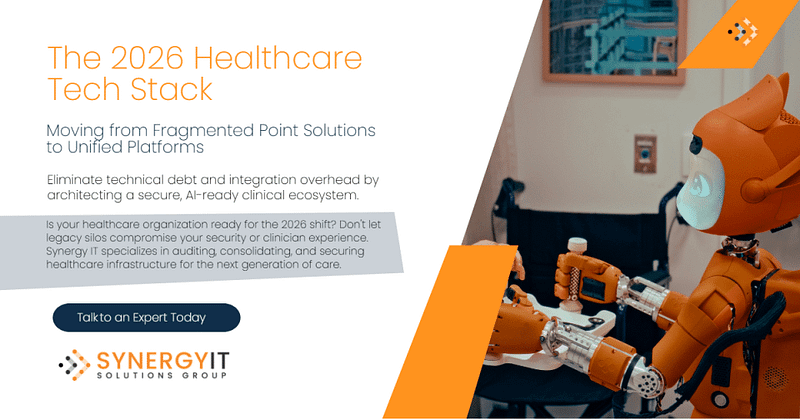
The 2026 Healthcare Tech Stack: Consolidating Point Solutions into Unified Platforms
Why Healthcare IT Must Change in 2026
Healthcare organizations are reaching a breaking point. Over the last decade, hospitals, clinics, and healthcare networks have adopted dozens—sometimes hundreds—of point solutions to solve isolated problems: EHR add-ons, security tools, patient engagement apps, analytics platforms, billing systems, compliance tools, and cloud services.
By 2026, this fragmented approach is no longer sustainable.
Healthcare leaders are now searching for answers to questions like:
- How do we reduce IT complexity without risking patient care?
- How can we improve security and compliance while controlling costs?
- How do we integrate AI, data, and cloud without breaking existing systems?
The answer is a unified healthcare technology stack—platform-driven, secure-by-design, and aligned with clinical and business outcomes. See how this applies to your healthcare IT environment.
The 2026 healthcare tech stack is a consolidated, interoperable set of platforms that replaces disconnected tools with integrated capabilities across:
- Clinical systems
- Cloud infrastructure
- Data & AI
- Cybersecurity
- Identity & access
- Operations and compliance
Instead of managing dozens of vendors, healthcare organizations manage fewer, more powerful platforms that work together. Understand how this fits into your 2026 healthcare IT roadmap.
Healthcare organizations adopted point solutions to solve immediate problems—but over time, this approach has created fragmented systems, rising costs, and hidden risks. In 2026, these disconnected tools are actively holding healthcare IT back instead of enabling better care and operational efficiency.
1. Operational Complexity
Each point solution requires:
- Separate contracts
- Individual integrations
- Ongoing maintenance
- Staff training
This complexity increases IT workload and slows innovation.
2. Security & Compliance Gaps
More tools mean:
- More attack surfaces
- Inconsistent security policies
- Higher risk of HIPAA violations
Healthcare remains one of the most targeted industries for cyberattacks.
3. Rising Costs Without Clear ROI
Point solutions often:
- Duplicate functionality
- Increase licensing costs
- Provide limited business value visibility
Leaders struggle to justify spend to boards and regulators.
The modern healthcare tech stack in 2026 relies on unified platforms rather than disconnected tools. These core pillars ensure security, interoperability, scalability, and measurable business value across healthcare operations. Get a personalized healthcare tech stack assessment.
Cloud-First, Hybrid-Ready Infrastructure
Healthcare organizations are moving toward:
- Secure hybrid cloud architectures
- Scalable workloads for imaging, EHRs, and analytics
- Built-in redundancy for resilience
Business benefit: Faster deployments, predictable costs, improved uptime.
Unified Identity & Access Management
Identity is now the security perimeter.
A modern healthcare tech stack includes:
- Centralized identity across clinical and non-clinical users
- Role-based and least-privilege access
- Secure third-party and vendor access
Business benefit: Reduced breaches, simplified audits, safer patient data access.
Integrated Cybersecurity Platforms
Instead of isolated security tools, healthcare organizations are consolidating into:
- Unified threat detection and response
- Continuous vulnerability management
- Automated incident response
Business benefit: Lower risk, faster response, simplified compliance reporting.
Data, Analytics & AI Platforms
Healthcare data is only valuable when it is accessible and secure.
Unified platforms enable:
- Centralized data lakes
- AI-driven clinical and operational insights
- Predictive analytics for patient outcomes and resource planning
Business benefit: Better decision-making, improved patient care, operational efficiency.
Interoperability & Integration Layers
Modern healthcare stacks rely on:
- API-first architectures
- Standards-based interoperability
- Seamless data exchange between systems
Business benefit: Reduced manual work, fewer errors, improved clinician experience.
How Unified Platforms Solve Real Healthcare Business Problems
Unified healthcare platforms address real operational, security, and cost challenges by replacing fragmented tools with integrated capabilities. Instead of managing problems in silos, healthcare organizations gain centralized visibility, stronger control, and measurable business outcomes across clinical and IT operations.
Problem: Too Many Vendors, Too Little Visibility
Solution: Platform consolidation with centralized dashboards and governance.
Problem: Rising Cyber Risk
Solution: Integrated security, identity-first access, and automated monitoring.
Problem: AI Adoption Feels Risky and Expensive
Solution: Governed AI platforms with cost controls and compliance built in.
Compliance in 2026 is no longer about reacting to audits—it’s about building compliance directly into the technology stack. A unified healthcare platform simplifies regulatory requirements by centralizing controls, standardizing security policies, and providing continuous visibility across systems, users, and data.
A consolidated stack simplifies compliance with:
- HIPAA
- HITECH
- Regional healthcare regulations
Unified reporting, centralized logging, and standardized controls reduce audit fatigue. Get a personalized healthcare tech stack assessment.
Consolidating healthcare technology requires a structured, low-risk approach that prioritizes patient care, security, and operational continuity. This roadmap outlines how healthcare organizations can move from fragmented systems to unified platforms without disruption.
Phase 1: Assess & Rationalize
- Inventory tools and platforms
- Identify overlaps and risks
- Define consolidation goals
Phase 2: Platform Selection
- Choose interoperable, healthcare-ready platforms
- Prioritize security and compliance
Phase 3: Migrate & Integrate
- Gradual migration to avoid clinical disruption
- Strong change management
Phase 4: Optimize & Govern
- Continuous optimization
- Executive dashboards
- Ongoing compliance monitoring
Common Mistakes Healthcare Organizations Must Avoid
As healthcare organizations modernize their technology stacks, many initiatives fail not because of the technology itself, but due to strategic and execution missteps. Understanding these common mistakes helps leaders avoid disruption to patient care, security gaps, and unnecessary costs during consolidation and transformation efforts.
- Consolidating without a roadmap
- Ignoring clinician workflows
- Treating security as an add-on
- Focusing only on cost savings
Successful consolidation balances care quality, security, and efficiency.
How Synergy IT Helps Healthcare Organizations Modernize
Synergy IT helps healthcare providers:
- Design unified healthcare tech stacks
- Consolidate tools without disruption
- Embed security and compliance
- Optimize cloud and operational costs
Our approach is business-led, compliance-first, and execution-focused. Let’s discuss how healthcare organizations implement this successfully.
Is Your Healthcare Tech Stack Ready for 2026?
If your organization struggles with:
- Too many disconnected systems
- Security and compliance pressure
- Rising IT costs
It’s time to rethink your healthcare technology strategy. Talk to a Healthcare IT Strategy Expert.
FAQs:
How can healthcare organizations reduce IT sprawl?
By consolidating overlapping tools into unified platforms that deliver multiple capabilities under one governance model.
Can consolidation improve security?
Yes. Unified platforms reduce attack paths, centralize identity management, and simplify monitoring and response.
Will consolidation disrupt patient care?
When done correctly, consolidation improves system reliability and clinical workflows.
Final Takeaway for Healthcare Leaders
The future of healthcare IT is not more tools—it’s fewer, smarter platforms. By consolidating point solutions into unified platforms, healthcare organizations can improve patient care, strengthen security, and control costs in 2026 and beyond.
Synergy IT | Healthcare Technology Strategy, Security & Platform Modernization
Contact :
Synergy IT solutions Group
US : 167 Madison Ave Ste 205 #415, New York, NY 10016
Canada : 439 University Avenue, 5th Floor, Toronto, ON M5G 1Y8
US : +1(917) 688-2018
Canada : +1(905) 502-5955
Email :
info@synergyit.com
sales@synergyit.com
info@synergyit.ca
sales@synergyit.ca
Website : https://www.synergyit.ca/, https://www.synergyit.com/


Comments
Post a Comment